
Like a defibrillator,
but for allergies.
We're invested.
Two founders in North London had built something that stops an allergic reaction from killing someone. In 2023 almost nobody who needed one knew it existed, not the schools, and not the employers, stadiums and visitor attractions that came later.
We didn't pitch Kitt. We invested. Yaniv's son and co-founder Zak Marks live the same reality every day, so this was never an account to win.
And being found was only half the job. Kitt is a regulated medical product, so who is allowed to book a meeting is a compliance question rather than a preference. A lot of the work was screening people out.
Kitt Medical company totals · Kitts, reactions and training as of 2 September 2026; venues as of 27 July 2026.
For the commercial answer up front: 347 deals won from paid since 2023, at 2.4× first-year ROAS and over 1,500 sales-qualified leads. The numbers, with their scope: the rest of this page is how.
2023. A product that worked, and hardly anyone had found it.
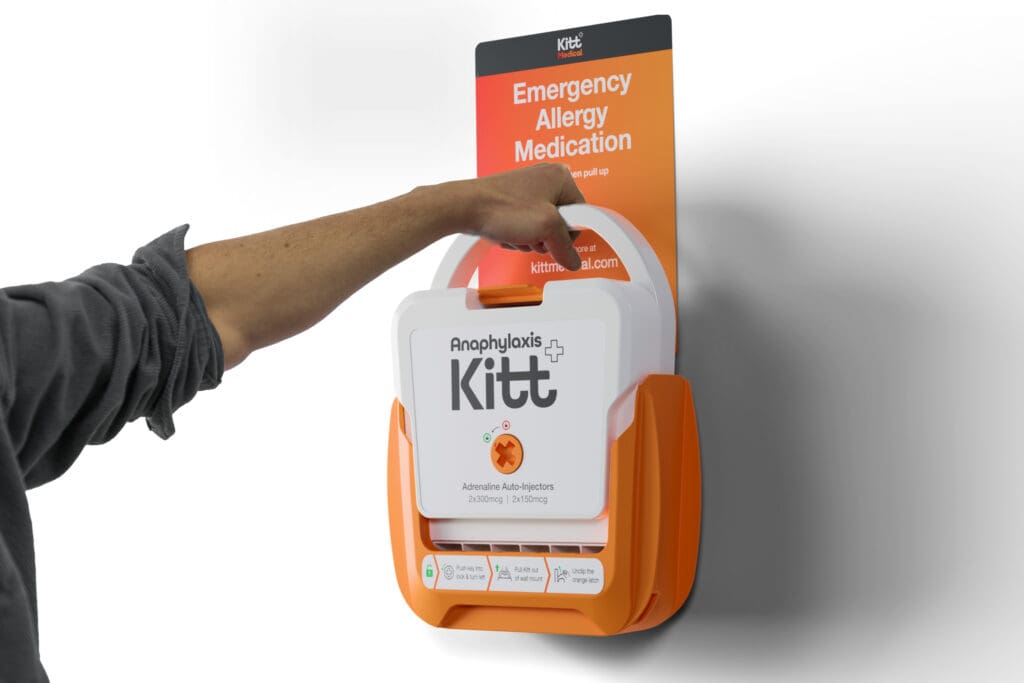
Kitt Medical was two founders, a pilot in a handful of schools, and a wall-mounted managed-subscription kit: adrenaline, ongoing training and automatic replenishment, placed where a reaction was most likely to happen. The product worked. Zak was already creating real demand the authentic way, founder-led, telling his own story on social. What it lacked was amplification, and a system to prove what was working and put money behind it.
That's why Mazorda came in as operators rather than a hired agency. So we'll let Zak tell it.
Awareness to build at scale.
Nobody was typing “managed anaphylaxis subscription”, whether they ran a primary school or a national logistics network. Standard paid playbooks assume searchable demand. We had to build the vocabulary and the reach in parallel.
Two audiences, one budget.
Kitt needed decision-makers who'd put a kit on the wall, and investors who'd fund the next stage. Different messages, different rooms, on a budget a pharma company would spend on lunch.
A mission that couldn't afford waste.
Every pound spent inefficiently was a kit that didn't reach a wall, which made the media plan a clinical decision as much as a commercial one.
A regulatory window, now open.
Benedict's Law was placing new anaphylaxis-preparedness duties on schools, and most didn't yet know what meeting them looked like. It took effect in September 2026. Every state school in England now needs an allergy safety policy, with spare pens and staff training expected now and statutory from the New Year. The chance was to be the obvious answer at the moment they started asking.
Volume was the wrong target.
Kitt sells a prescription-only medicine inside a managed service, so it cannot simply sell to whoever raises a hand. Only certain kinds of organisation can legally hold one, and only certain people inside them can authorise it. A lead that clears none of those bars costs the same to generate and can never close. Getting found by the right people through the right keywords was half the brief. The other half was disqualifying everyone else fast, and giving the founders' time back to the enquiries that could actually become a kit on a wall.
Built by someone who lives it.
“I've lived with severe allergies my entire life, and I'm on a mission to create a new standard for allergy care.”
“Allergy is often misunderstood. The stigma and the burden cause daily anxiety, exclusion, and too often bullying — especially at school — and avoidable deaths keep hitting the headlines.”
“So I built something just like a defibrillator, but for allergies. Our goal is to become every defibrillator's next-door neighbour.”
We had to build the reach first.
Kitt's demand didn't exist yet, so we had to create it and then be the answer waiting the moment it turned into a search. In the order it happened:
Founder-led narrative, amplified.
Kitt's founders had the story and we built the channels to carry it. The paid creative leaned on the mission and the medical stakes instead of feature lists: Zak's own allergy, the “defibrillator, but for allergies” idea, and later the Dragons' Den credibility. It kept working because it stayed in his voice rather than being handed to an agency to polish.
The funnel we had backwards.
Nobody was searching for Kitt by name. They were searching the problem. A bursar who has just realised the school isn't prepared types “anaphylaxis training for schools”. A facilities lead at a distribution centre types “adrenaline pens for the workplace”. A safety manager at a theme park types something else again. High intent, low competition, and three different vocabularies for the same fear. We made sure Kitt was the answer waiting at all of them.
Then the pages they landed on had to carry it. We built those around the mission, the subscription model and the medical credibility, instead of the generic SaaS framing a first-time visitor would have discounted on sight.
Built before the wave hit.
Before Dragons' Den aired we built for the flood. Every enquiry went from Typeform into Clay and was enriched against Kitt's compliance criteria before a human ever saw it: what kind of organisation this is, how many sites it runs, and whether the person filling in the form can authorise a prescription-only medicine.
Most of what that scoring does is say no. A parent asking on behalf of a school, a student writing a project, a supplier looking for a reseller deal. All real people, none of them a sale Kitt is allowed to make. They get a straight answer and an info pack instead of a sales process. What reached Slack was the short list worth the founders' evening, best ones first, and on the night the episode aired we watched it land live.
The reporting that tied it together.
A lean budget can't guess where growth comes from. So we built one source of truth in Looker (fed by GA4, Google Ads, Meta, Bing and the CRM) that reads the same pipeline two ways at once: by the day each lead was created, and by the day it actually moved.
Run together, down to the keyword and the creative, they trace every enquiry from first ad click to a kit on the wall. That ended the arguments about which channel deserved the credit, because the numbers answered it.
That reporting is also what makes the next month better than the last. Renewals and multi-year agreements feed back into how we bid, so budget follows what actually returned rather than what looked busy.
BBC's Dragons' Den.
In 2025, co-founders Zak Marks & James Cohen pitched on BBC's Dragons' Den and secured investment from Deborah Meaden and Steven Bartlett. National reach also widened who came looking, which is why names like DHL, Compass Group and Haven now sit alongside the multi-academy trusts.
Seen the pitch? The kit itself: kittmedical.com ↗





What all of it was actually for.
Fifty-two times so far, in a school or an office or a stadium, a kit on the wall and someone trained to use it have stopped a life-threatening allergic reaction. Adults as often as children.
Source: Kitt Medical · 2 September 2026
A teacher with no known allergy survived a sudden life-threatening reaction, treated in seconds with the adrenaline pen from the Kitt on the wall.
Below is the paid performance that funded the expansion. Every figure traces from an ad click to a kit on a wall.
Paid-media performance, 2023 → present (Looker; UTM + self-attribution stitch), reviewed with Kitt Medical July 2026. Growth shown vs. engagement start; lifetime value compounds further as subscriptions renew. The lives, kits, venues and training figures above are Kitt company-wide totals, not Mazorda-attributed.
Want an engine like this behind your pipeline? Book a call
The founders, in their own words.
Both approved by the founders, July 2026. Zak wrote his himself.
“I've always told the Kitt story — my allergy, the ‘defibrillator for allergies’ idea. Mazorda built that story an engine: paid social to carry my voice, search to catch every school it reached. One of my videos alone brought in over a hundred enquiries in a single month through paid advertising — and that engine has now put Kitt on the walls of thousands of schools and workplaces across the UK.”
“Mazorda built one source of truth across Google, Meta, Bing, and our CRM — every deal traced back to the keyword or creative that won it, with closed deals fed back into the bidding so the campaigns learn from real revenue. Since 2023 that engine has produced over 1,500 sales-qualified leads, and every pound into paid returns £2.40 in first-year deal value before a single renewal. It pays for itself on day one and compounds from there.”
Zak's quote is reproduced as he wrote it, 27 July 2026; the wall count in it is Kitt's company-wide total, not a Mazorda-attributed figure. The figures in James's quote are Mazorda-attributed paid performance (see The Results).
Know a school that should have one? Email them.
Demand for Kitt gets created rather than searched for, and a concerned parent or teacher is the warmest introduction there is. This tool writes a ready-to-send email to a headteacher in under a minute. It runs entirely in your browser and you send it yourself.
Open the “Email my school” toolClose the “Email my school” tool
Your email
Nothing is sent or stored here. You send it yourself, from your own email, to your own school.
Ask your class group too (optional)
A short message for the parents’ WhatsApp group, so more than one voice reaches the head.
Prefer a shareable link? Point anyone to mazorda.com/kitt/email-my-school.
Know a wall that needs a kit?
Every defibrillator's next-door neighbour.
Kitt's mission is a kit on every wall where a reaction could happen, in place before it happens. If you know a school, an employer or a venue that should have one, point them to Kitt.
And if you're a founder who needs growth built by people who treat it like their own:
Senior operators. No account managers. Pipeline, engineered.